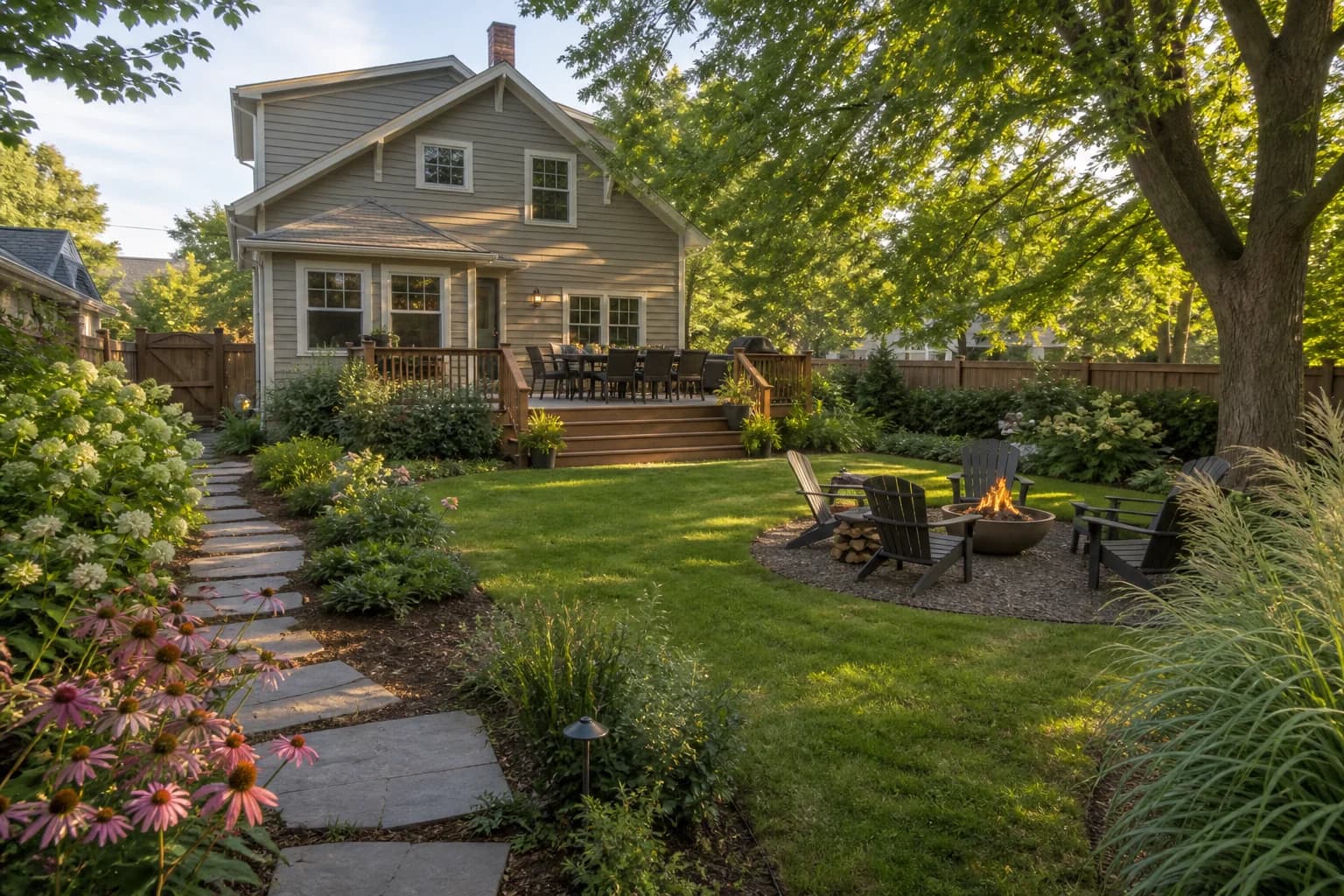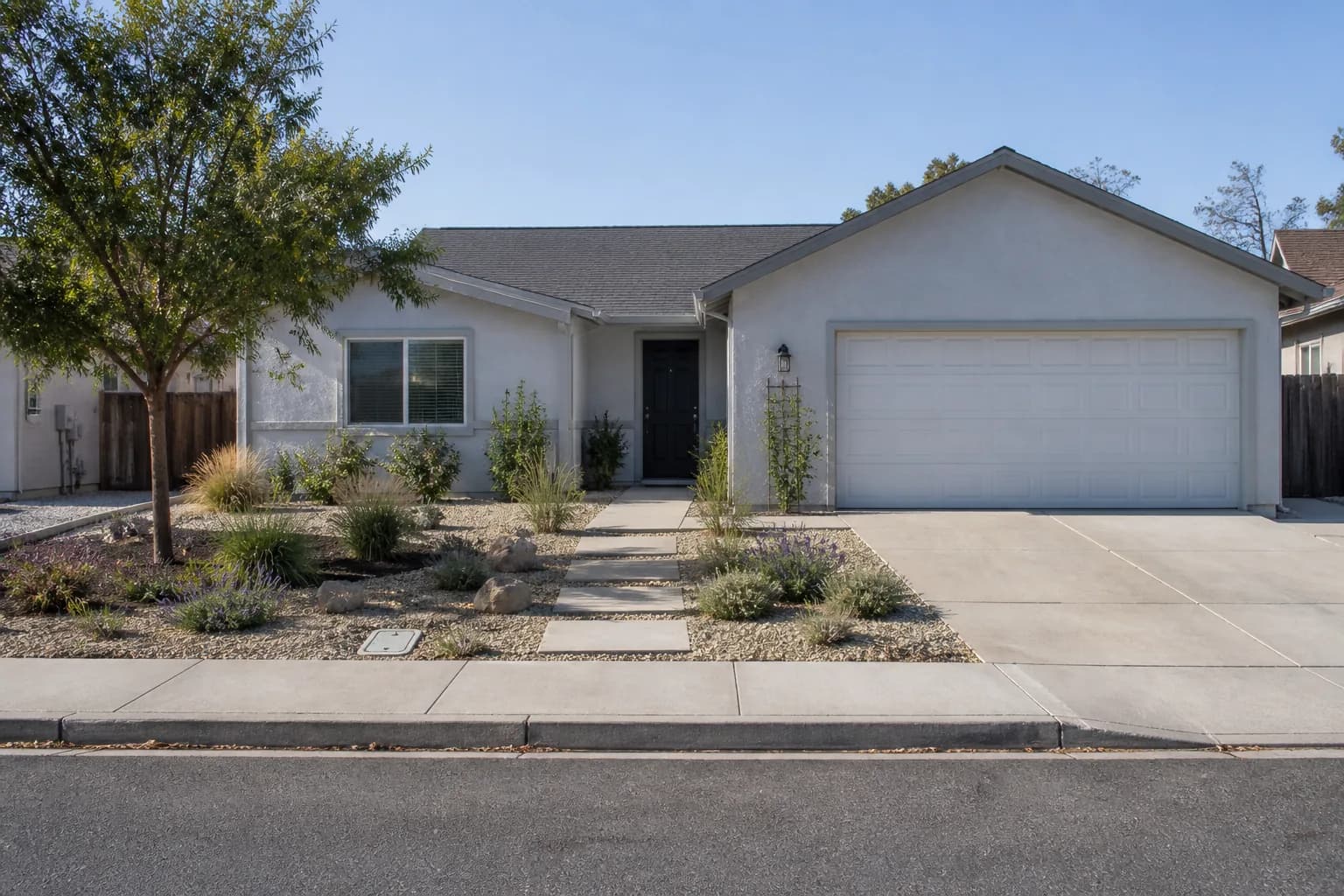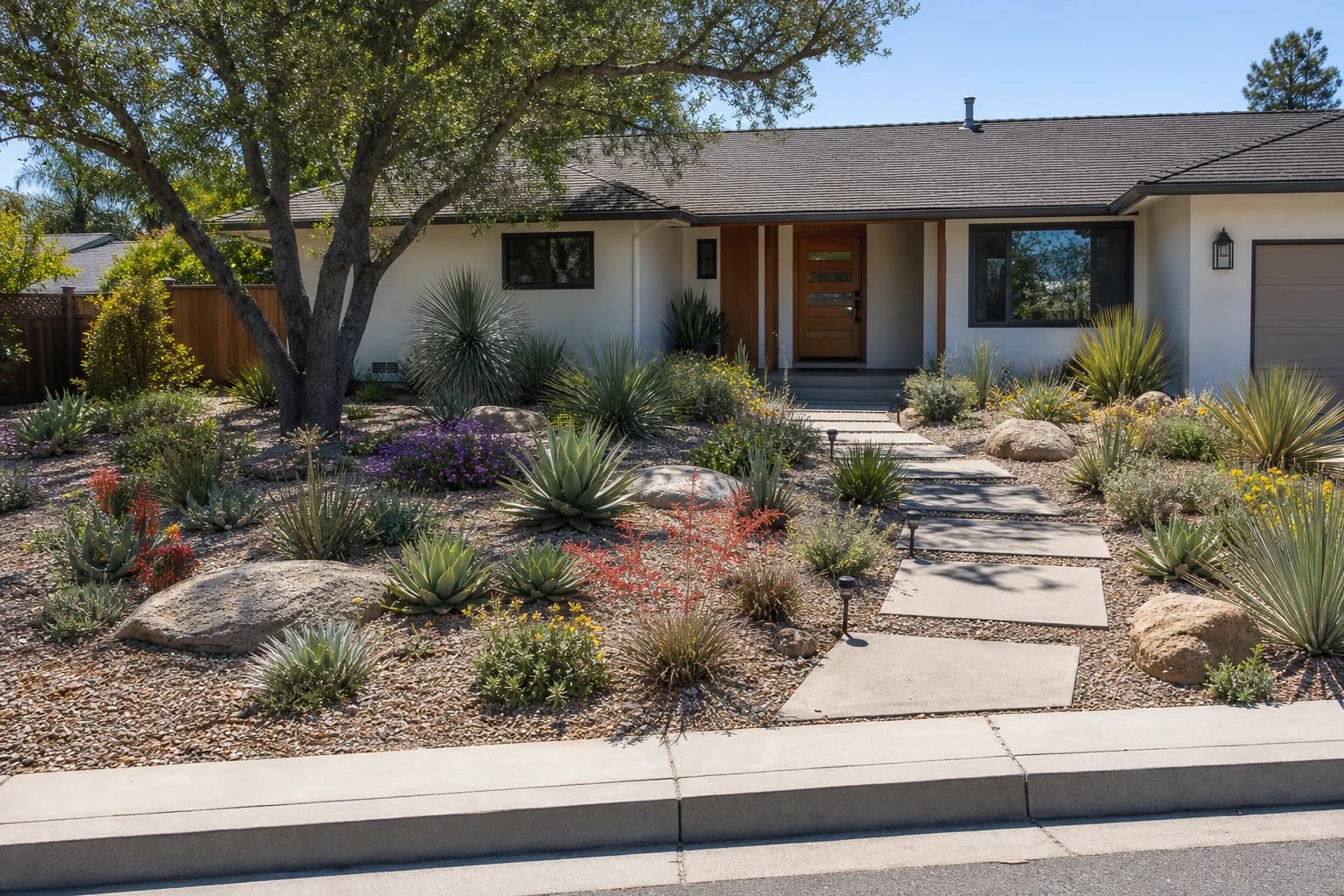
The useful answer is rarely “mulch everywhere” or “rock everywhere.” Organic mulch is usually the stronger default around trees, shrubs, and perennial beds because it moderates soil conditions and gradually contributes organic matter. Rock can be the better surface in non-planted utility strips, dry-climate compositions, high-wind spots, drainage-detail applications, and selected fire-wise zones—if its size, depth, edging, and maintenance match the site.
This guide treats mulch and rock as working materials, not just colors in an inspiration photo. It combines university-extension guidance with current landscape-industry comparisons, then separates evidence from the choices that still depend on climate, plants, slope, irrigation, nearby trees, and local fire rules.
Quick verdict by yard condition
| Yard condition | Usually start with | Reason |
|---|---|---|
| Trees, shrubs, and perennial beds | Organic mulch | Supports soil, roots, moisture, and temperature moderation |
| Hot full-sun bed with moisture-loving plants | Organic mulch | Rock can store and reradiate heat around plants |
| Non-planted strip beside paving | Rock | Durable surface where soil improvement is not the goal |
| Windy site where light mulch migrates | Heavier mulch or correctly sized rock | Material weight and edging matter |
| Concentrated roof runoff or swale detail | Engineered stone detail | Size, base, outlet, and erosion design matter—not appearance alone |
| Leafy yard under deciduous trees | Mulch | Leaves and small debris are easier to incorporate than extract from rock |
| Wildland–urban interface | Local fire-wise plan | Noncombustible zones may help, but vegetation spacing and maintenance remain critical |
Mulch vs. rock at a glance
| Decision factor | Organic mulch | Landscape rock |
|---|---|---|
| Soil over time | Decomposes and can add organic matter | Does not feed soil; fines and dust collect between pieces |
| Root-zone temperature | Buffers heat and cold when applied correctly | Can absorb and reradiate heat, especially dark stone |
| Water | Reduces surface evaporation and rain impact | Can allow infiltration, but size/base/slope may also move water quickly |
| Weeds | Suppresses many seedlings at adequate depth | Suppresses initially; windblown soil eventually supports weeds |
| Renewal | Top up as it decomposes | Less frequent material addition, but cleaning and resetting remain |
| Leaf cleanup | Debris can blend or decompose | Blowing or picking leaves without moving stone takes care |
| Removal | Can be incorporated or replaced more easily | Heavy to remove; fabric, soil, and stone often mix |
| Visual character | Soft, planted, woodland, productive | Dry, mineral, crisp, architectural |
Plant and soil health: why organic mulch is often the default
University of Minnesota Extension recommends organic mulch for many planting situations because it conserves moisture, moderates soil temperature, reduces erosion and compaction, and improves soil as it breaks down. A typical depth is about 2–4 inches, adjusted for material and site.
More is not better. Keep mulch away from trunks and stems; a mulch volcano holds moisture against bark, can hide decay and rodents, and encourages roots into the wrong layer. Do not bury the root flare. On wet, poorly drained soil, correct the water problem rather than hiding it under deeper mulch.
Rock does not automatically kill plants, but it changes their root-zone environment. Dark or dense stone in strong sun can store heat, and a permanent mineral layer makes compost additions, division, bulb planting, and redesign more laborious. Drought-tolerant plants still need species-appropriate soil and irrigation during establishment; “xeric” does not mean no water or no maintenance.
Drainage depends on stone size and construction—not the label “rock”
Colorado State University notes that rock size changes water behavior. Small gravel can suppress weeds and reduce evaporation, while pea gravel can allow infiltration; larger rocks can increase runoff. That is why copying a decorative river-rock channel may fail: the subgrade, filter layer, slope, inlet, capacity, and legal outlet determine whether it manages stormwater or simply redirects it toward a foundation or neighbor.
For a path, decide whether the surface must remain firm for chairs, wheels, or regular walking. Rounded pea gravel rolls; angular compactable gravel behaves differently. For a drainage feature, obtain site-specific advice where water could affect a building, slope, retaining wall, public drainage system, or adjacent property.
Weed fabric: useful separator or future cleanup problem?
Landscape fabric does not make rock maintenance-free. It may temporarily separate clean aggregate from soil and reduce mixing in a non-planted application, but windblown dust, leaves, and organic debris accumulate above it. Weeds then root in that new layer, while fabric tears, appears at edges, tangles with roots, and complicates planting changes.
In beds that should improve biologically or be replanted often, repeated organic mulch and hand removal of young weeds may be a more adaptable system. Under hardscape or a specified aggregate assembly, use the base and geotextile called for by the design rather than treating thin retail weed fabric as a structural layer.
Fire-wise landscaping needs more than replacing bark with stone
Noncombustible gravel can be appropriate immediately next to structures in some wildland–urban interface guidance, but Colorado State University stresses that an all-rock landscape is not automatically the most fire-resistant solution. Plant selection, spacing, pruning, irrigation, removal of dead material, separation from combustible fences and decks, and local defensible-space rules all matter.
Do not generalize one jurisdiction's clearance distance to every home. Follow your fire authority, insurer, and local extension guidance. A green, maintained, well-spaced landscape can perform differently from dry weeds growing through neglected gravel.
Compare total ownership cost, not just the first delivery
Organic mulch usually has a lower initial material burden but needs periodic top-ups. Rock often costs more to buy, deliver, edge, and install, yet the material itself does not decompose. Its long-term work moves to blowing leaves, removing weeds, recovering migrated stones, refreshing edges, and eventually separating contaminated rock from soil.
For a first-pass mulch quantity, cubic yards ≈ area in square feet × depth in inches ÷ 324. For example, 600 square feet at 3 inches is about 5.6 cubic yards before a sensible waste/settlement allowance. Rock coverage varies significantly by density, gradation, and depth, so use the supplier's product-specific coverage rather than a universal conversion.
| Include in both quotes | Mulch-specific | Rock-specific |
|---|---|---|
| Area, depth, bed preparation | Material type and decomposition rate | Stone type, size, density, and base |
| Delivery and difficult access | Top-up frequency and color change | Equipment, edging, and migration |
| Weeding and seasonal cleanup | Keeping clear of stems and trunks | Leaf extraction and fines buildup |
| Removal or redesign | Composting/disposal options | Weight, fabric removal, soil separation |
A mixed-material plan that is easier to live with
- Map plant root zones, intense sun, roof runoff, utility access, leaf fall, walking routes, and the first 5 feet around structures where local fire guidance may apply.
- Use organic mulch where soil life and plant growth are priorities. Keep the correct clearance from stems and trunks.
- Use rock where a mineral surface solves a defined job: non-planted strip, dry-climate composition, equipment access, or a designed drainage/fire-wise detail.
- Install a deliberate edge where materials meet. Without it, mulch floats into rock and stones migrate into soil or turf.
- Test a small area through one hot season and one leaf season before covering the entire yard.
- Write a maintenance plan: who blows leaves, weeds, tops up mulch, resets edges, and keeps combustible debris out of rock zones?
Use a visual concept to compare placement, not prove performance
GardenGPT can help compare the visual balance of planted beds, mulch, gravel, larger stone, and paths on a photo of the actual yard. Preserve mature plants and drainage features in the prompt so the comparison is about material placement rather than an imaginary empty site.
An image cannot identify soil type, root flare, compaction, drainage capacity, underground utilities, stone gradation, local plant suitability, or fire-code compliance. Confirm the detail with a local horticulture, drainage, arboriculture, or fire-wise professional when those conditions matter.
Frequently asked questions
Is rock or mulch better for preventing weeds?
Both suppress many weeds when prepared and maintained correctly, but neither is permanent. Organic debris eventually creates a seedbed above rock and fabric; mulch thins as it decomposes. Remove weeds early before they seed.
Does rock hurt plants?
Not automatically. Problems arise when stone increases root-zone heat, conflicts with moisture needs, buries stems, compacts soil, or makes ongoing soil care difficult. Match the material to plant and climate.
How deep should mulch be?
University extension guidance commonly recommends roughly 2–4 inches depending on material and setting. Keep it away from trunks and stems and avoid burying the root flare.
Should landscape fabric go under rock?
It can act as a separator in some non-planted aggregate applications, but it does not eliminate weeds and may complicate future planting and cleanup. Use an assembly suited to the actual function.
Is rock always better for drainage?
No. Stone size, subgrade, compaction, slope, inlet, and outlet control water behavior. A decorative layer alone does not fix drainage.
Is rock always safer in a wildfire area?
No. Noncombustible zones can be part of a defensible-space plan, but maintenance, spacing, vegetation condition, fences, decks, and local rules are also decisive.
Which is cheaper over ten years?
It depends on local material and labor prices, mulch top-up frequency, leaf cleanup, rock contamination, edging, and redesign. Compare a ten-year maintenance schedule rather than only delivery cost.
Can I mix mulch and rock?
Yes—and zoning is often the best answer. Give each material a job and install a stable edge so they do not mix.
Choose the surface by the job it must do. Feed and buffer planted soil with appropriate organic mulch; use rock where a durable mineral layer solves a defined site problem; and design the transition and maintenance before ordering either material.